Banking
Splitting the price doesn’t change it — it changes how much it hurts to pay
Wenalyze. 6 November 2026. 8 min read
Splitting a payment into instalments doesn’t change the price of anything. The product costs the same, the consumer pays the same total, and yet they buy differently: they buy more, they buy pricier items, and they buy faster. That gap between what objectively changes (nothing) and what psychologically changes (almost everything) is why instalment payment has gone from being a financing option for furniture and appliances to becoming, through Buy Now, Pay Later (BNPL), the default checkout method of online retail.
This article reviews what behavioural economics research says about three specific effects of being able to pay in instalments: how it changes price perception, how it changes purchase intention, and what ultimately happens to the consumer’s actual spending — including the less favourable side of the phenomenon, the overspending and purchase regret that regulators and 2025-2026 surveys are starting to document.
The pain of paying, and why splitting it reduces it
The core concept for understanding everything else is the pain of paying, coined in 1996 by Ofer Zellermayer in his doctoral thesis at Carnegie Mellon, supervised by George Loewenstein: the negative emotional reaction we feel at the moment of paying. The reason it exists is simple — handing over money is processed, psychologically, as a loss, and because of loss aversion that feeling is disproportionately negative compared with the pleasure of receiving what we bought (the theoretical framework of price as an aversive stimulus also appears in Prelec and Loewenstein, 1998, «The Red and the Black», Marketing Science 17(1)).
What matters for instalment payment is the mechanism of decoupling, described by Raghubir and Srivastava (2008, «Monopoly Money», Journal of Experimental Psychology: Applied 14(3)): when payment happens at the same time as receiving the product, the pain of paying and the pleasure of consuming are felt together and partly cancel each other out. When payment is separated from delivery — as happens with a credit card, and even more markedly with an instalment plan — the pleasure is felt immediately and the pain is deferred, sometimes for months. You buy the whole thing today and pay for it in pieces tomorrow.
There’s a second, complementary mechanism: rehearsal and immediacy, from Dilip Soman (2001, «Effects of Payment Mechanism on Spending Behavior», Journal of Consumer Research 27(4), 460-474). Soman showed that an earlier payment only curbs future spending if the consumer recalls it accurately and experiences its full aversive impact — two conditions that depend on the payment method. A small, automatic, monthly instalment registers far more weakly in memory than a single large payment made all at once: there’s nothing to «rehearse» or feel with the same intensity.
Instalment payment combines both effects: it decouples payment from consumption, and it fragments payment into units too small to hurt or to be remembered well. The result isn’t that the consumer becomes less rational — it’s that, quite literally, they feel less.
Price perception and purchase intention: the anchor is the instalment, not the total
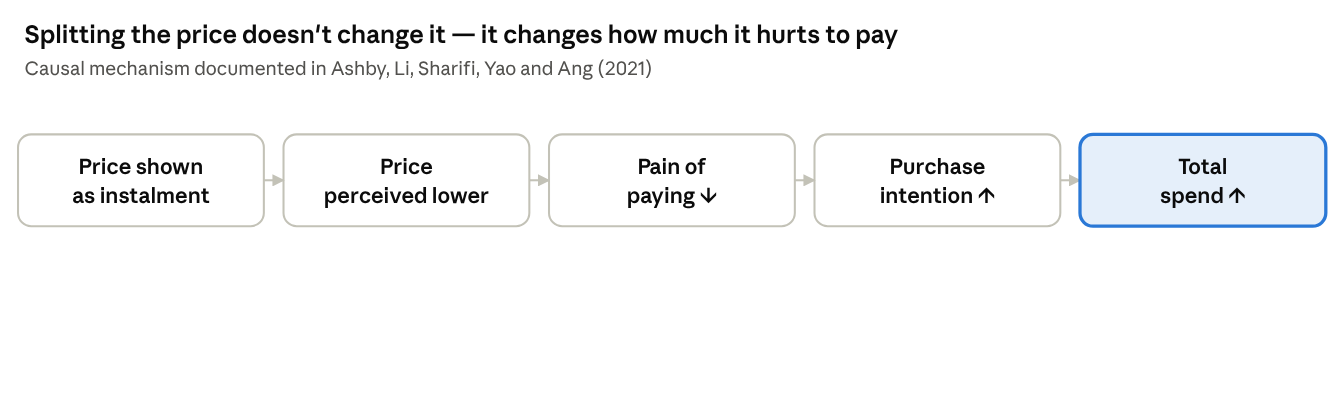
The most direct experimental evidence on instalment payment comes from Ashby, Li, Sharifi, Yao and Ang (Macquarie University, ANZMAC 2021), who ran four experiments on the effect of instalment payment on spending. Their causal chain is precise:
- Showing the price as an instalment («3 payments of £20») rather than as a total («£60») makes the consumer perceive the product as cheaper than it is — not through deliberate deception, but through a cognitive bias known as the numerosity heuristic: the brain anchors on the smaller, more visible figure (the instalment), not on the real sum.
- That perception of a lower price directly reduces the pain of paying described in the previous section.
- Less pain of paying translates into higher purchase intention — and, particularly relevant for retailers, into a higher likelihood of choosing the pricier option within a catalogue, not just buying more units.
The study itself finds something worth underlining: the effect appears with instalment payment specifically, but not with a traditional credit card on the same total amount. It isn’t simply that «deferring makes you pay more» — it’s that showing the price already fragmented at the moment of deciding changes the mental arithmetic of the purchase decision, while classic credit doesn’t reframe the price in the same way.
The design implication is uncomfortable but clear, and the authors themselves point to it: how the instalment price is presented — not just the fact of offering instalments — is a conversion lever. It’s also, according to the same study, where the case for regulatory intervention starts to take shape: if the effect depends on how the price is displayed, regulating that presentation — not just the financial product itself — is a real way to protect consumers without banning instalment payment outright.
The effect on spending: basket size, impulse, and the downside
2025-2026 market data confirms at scale what the experiments predict in the lab. According to PayPal, the average order value of an instalment-paid purchase is more than 80% higher than a standard checkout, and offering the option to split payment can lift conversion rates by 20% to 30% (Fortunly, «Buy Now, Pay Later Statistics for 2026»). Empower puts the typical increase in basket size at 10% or more when instalment payment is available, and calculates that average monthly spend per BNPL user rose nearly 21% in a year, from $201.60 to $243.90. Asked directly, consumers admit it themselves: 49% say BNPL leads them to buy more on impulse, and 46% admit to spending more than they would without that option (data collected by PartnerCentric, via Fortunly).
The less favourable side now has figures of its own, not just intuition. A Bankrate survey with YouGov of 2,276 US adults (875 BNPL users) found that 29% had spent more than they should using these services, 18% had missed a payment, and 18% had had trouble returning a product or getting a refund; overall, 56% had experienced at least one problem (Digital Transactions, on Bankrate’s report). The problem isn’t evenly spread across generations: 76% of Gen Z BNPL users report having had some problem, versus 65% of millennials, 42% of Gen X and 32% of baby boomers — exactly the pattern Soman’s rehearsal theory predicts: less accumulated financial experience means less capacity to «feel» the real cost of a small instalment.
There’s also a limit to the positive effect itself. Huang, Shangguan, Shao, Fang and Liu (University of Nottingham Ningbo, PACIS 2024) combined econometrics and experiments to study the optimal number of instalments, and found a curvilinear relationship: adding instalments boosts purchasing at first, but past a certain point the effect reverses and sales fall. Splitting payment too finely stops feeling «convenient» and starts feeling «worrying» — at some point, the consumer does, in fact, do the full sum.
And fragmentation accumulates: according to LendingTree, 23% of BNPL users were carrying three or more active loans at once, and 60% had more than one simultaneously — a pattern known as loan stacking that no single platform sees on its own.
What explains the BNPL boom
The three effects above — lower perceived price, higher purchase intention, higher actual spend — together form the commercial engine behind the growth of Buy Now, Pay Later. The volume figures reflect it (Fortunly, 2026):
- Projected global BNPL transaction volume (2026): $576bn, 2.3% of global e-commerce — GlobalData
- Klarna active users (end of 2025): 118 million, up 28% year-on-year — Klarna
- Volume processed by Affirm (2026 forecast): over $49bn, up 36% YoY in its fiscal Q2 — Affirm
- BNPL volume processed by PayPal (2025): over $40bn, up 20% YoY — PayPal
- BNPL spend over Black Friday/Christmas 2025, US: $20bn, up 9.8% YoY — Adobe
- US adults who have used BNPL at least once: ~50% — Numerator
- BNPL usage in the last 90 days (2025): 37%, up 5 points YoY — J.D. Power
Growth isn’t uniform: according to eMarketer, Gen Z already accounts for 30.2% of US BNPL users, and more than half of that generation’s digital shoppers have used the service. And according to Numerator, BNPL users are more likely than average to belong to urban households earning under $60,000 a year — in other words, the mechanism that most reduces the pain of paying disproportionately reaches those with the least room not to feel it.
What this means in practice
For a business selling something, the honest reading of this evidence isn’t «always offer instalments» but «how you show them matters as much as offering them.» The price effect — and with it a good share of conversion and average order value — depends on prominently displaying the instalment amount at the moment of decision, not on the mere existence of the financing plan. That’s simultaneously why BNPL works so well commercially, and why regulators — the FCA in the UK, the CFPB in the US, and equivalent consumer-credit rules in the EU — are starting to treat it for what it is: a credit product, with the same transparency obligations as any other, not simply a checkout feature.
For those designing these payment systems, there’s a useful distinction that follows directly from the data: the number of instalments has an optimum, not a «more is better» rule — past a certain threshold, splitting payment too finely triggers an alarm signal instead of relieving one, and the consumer starts rejecting the purchase. Designing instalment payment well isn’t about maximising the number of instalments; it’s about finding the point where payment stops hurting without stopping feeling real.
And for the consumer, once you know the mechanism, it’s fairly easy to neutralise: before accepting any instalment plan, simply do the calculation the price design is meant to stop you doing automatically — multiply the instalment by the number of payments, and compare that figure, not the instalment, with what you’re actually willing to spend.
Sources
- Pain of paying — Wikipedia
- Prelec and Loewenstein (1998), «The Red and the Black: Mental Accounting of Savings and Debt», Marketing Science 17(1), 4-28
- Soman (2001), «Effects of Payment Mechanism on Spending Behavior», Journal of Consumer Research 27(4), 460-474
- Ashby, Li, Sharifi, Yao and Ang (ANZMAC 2021), «The Instalment Payment Effect on Consumer Spending»
- Huang, Shangguan, Shao, Fang and Liu (PACIS 2024), «Buy Now Pay Later: Untangling the Nonlinear Effect of Installment Payment on Consumer Purchases»
- Bankrate / YouGov, on BNPL overspending and missed payments (via Digital Transactions)
- Fortunly, «Buy Now, Pay Later Statistics for 2026»
Market data as of November 2026; the Fortunly figures are second-hand (aggregator) — check the primary source cited in each case before reusing them as original data.